Tuesday, October 20, 2015

Getting class birds and teaching with them

As a follow-up to my Birds on the Brain post, as promised, here is what I have learned about finding birds for in the classroom, as well as the materials needed in order to take care of them. Also, I will go through the advantages and disadvantages of having different types of birds in the classroom.
My three year old daughter, meeting Junior when he first moved into my fourth grade class.

When I first started this adventure, I began by looking for zebra finches, since I had previously had a pair and knew that they are low maintenance. I searched on kijiji.ca, a Canadian equivalent to Craig’s List. There were several people who were looking to sell finches. There were pet shop owners, elderly people who were too busy or unwell to look after their birds and there were breeders who wanted to sell their finches. I found that for the type of experience I was looking to obtain for my students, I needed to be sure that the birds I purchased had already reproduced.

I decided that it would be best to buy my birds from a breeder, who was trying to downgrade and lower the number of birds that she kept for reproduction purposes. Because she was a breeder and already had an extra cage for the finches, she was selling the birds fully equipped with the cage, the nest stuffing, bird feeders, water containers, some bird food and lots of information to help me take better care of the birds. As a bonus, when she learned that I was purchasing them for my classroom and that students were going to benefit from the experience of having the birds in the classroom, she accepted my very low offer of only $30 for everything.

The finches have been incredible.

Advantages of having zebra finches:

They are low-maintenance, they require little attention and they are not noisy. They make the littlest chirps once in a while, which are endearing and not at all annoying. The finches are not demanding at all. In addition, they laid eggs almost every month for the first few months after I got them and my students had the opportunity to see the chicks hatch and grow to maturity.
 
Ping and Pong, my first zebra finch couple

Salt and Pepper, two of Ping and Pong's chicks


My next feat:

This year, with older students, I wanted to find another breed of bird that I could use in class to deepen my lessons with my new students. 

Originally, I had several criteria for my search:
I wanted a bird that we could handle and take out of the cage.
I wanted to use a bird to help calm and soothe my students.
I also wanted to have a different type of bird that the students could compare the finches to.

Lastly, I wanted for my students to experience the hatching and growing of another type of bird than finches.

I made a lot of phone calls. I called pet shops, breeders and people from kijiji.ca. I asked questions about all types of birds that may meet my needs for in the classroom. I read blogs, consulted various websites and realized that I could narrow down my search because I didn’t want a bird that lives too long (I can’t handle a fifty year commitment to a bird) and I wanted a bird that would be friendly and would not become aggressive with students. I also wanted to choose a bird that wasn’t too noisy or too expensive to take care of.

I visited Bourke parakeets, because I was told that these were ideal for in the classroom because they can usually be handled and they are quiet birds. When I saw them, I was not drawn to them at all. These little pink budgie-like birds were cute enough but very fearful and didn’t seem to want to be handled.

I saw Quaker parrots and Catherine and Celeste Touis, but I was told that these could be aggressive and that their nibbles hurt.

Lovebirds:

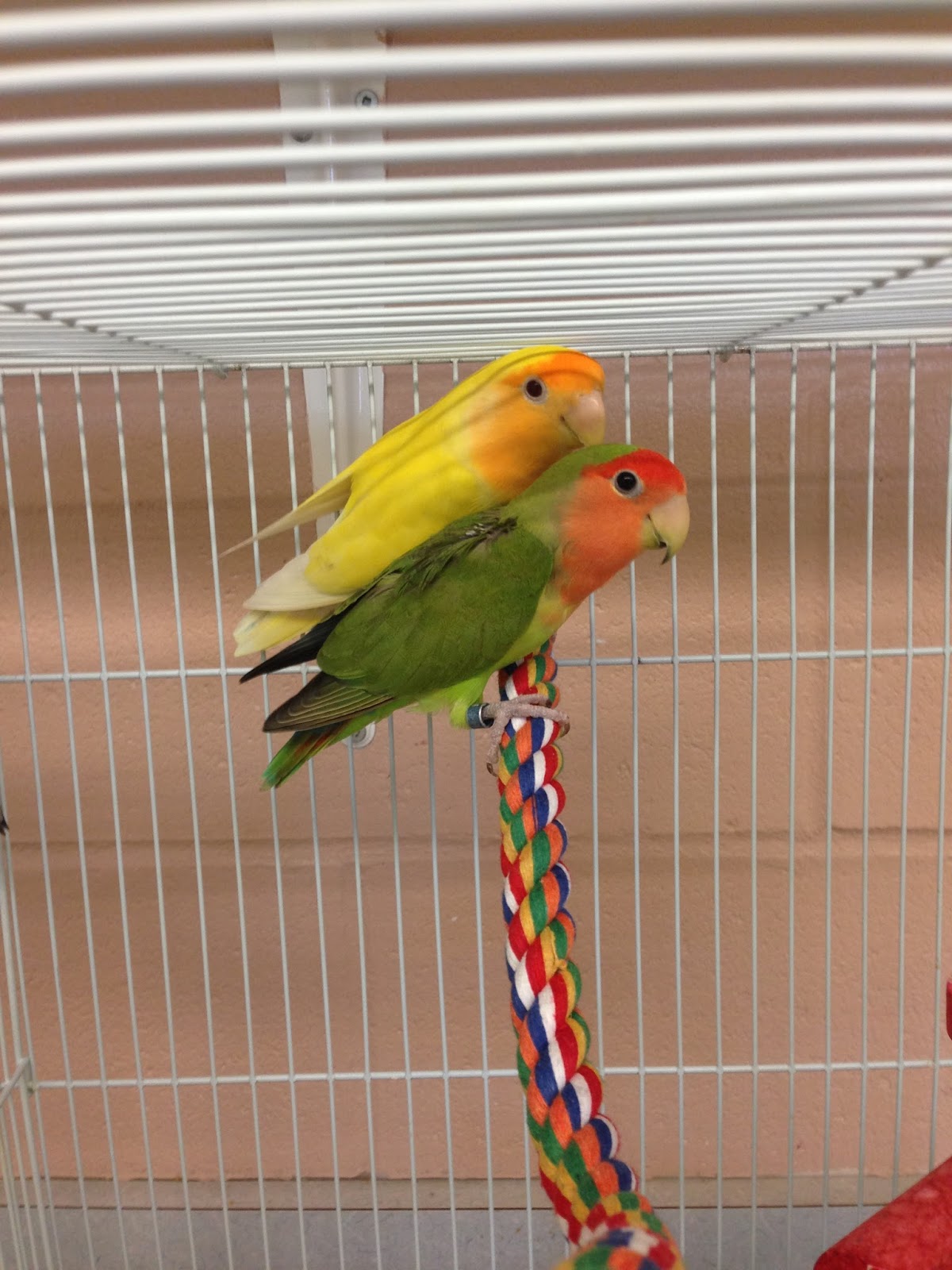
I decided to go for lovebirds. Peach-faced lovebirds, to be exact. I learned that the peach-faced variety is the least expensive to purchase from pet shops or from breeders. I finally found an individual on kijiji.ca that had two breeding pairs for sale. When I went to visit them, I originally wanted to purchase one pair of breeding birds and a baby lovebird that hadn’t found a mate yet.


(Fun Fact: Lovebirds who are already in pairs are difficult to handle. They are so attached to one another that they hate to be separated. However, when you have a single lovebird, it becomes attached to you!)

Jewel, Junior's mother

Blue, Junior's father


When I was visiting the birds, the owner wanted to sell them with the cages. He was selling them for his teenage son who had promised to take care of them but didn’t. He also had some babies from the breeding pairs for sale. I made an offer to purchase one pair and one baby with the cages. When he learned that I was a teacher and that the birds would be going into a classroom, he offered to sell both pairs, a baby and the cages, nests and equipment for only $130. (Lovebirds, in the pet store, usually cost at least $75 each.) I jumped on the opportunity and brought the birds to school with me.

Advantages of having lovebirds:

They are an entirely different type of bird from the finches. Their anatomy is different. They use their beaks to move around and climb things.

The single bird, whom we named Junior, is comfortable staying on students’ shoulders when they work and on my shoulder when I am teaching. The kids are already used to seeing Junior lose in the classroom. They have already become quite attached to him, and he to us.

The lovebirds are beautiful birds that are still somewhat low maintenance and are rather inexpensive versus the other types of birds that may have been interesting for a classroom setting.

The lovebirds have an interesting demeanor. It is very educational to watch them prepare their nests, to observe their interactions with each other and it will be an awesome experience for students to learn how to hand-feed the babies.

Disadvantages with lovebirds in the classroom:

With the number of them that I have in the classroom (5 in total), they can be quite noisy. Junior on his own doesn’t make a sound. The pairs, however, like to communicate a lot, especially in the morning. They are less noisy when I am in the classroom but when my colleagues enter the room to teach the birds do not behave the same way with them as they do with me.

Lovebirds require grooming if you want to be able to handle them and take them out of their cages. I have learned from YouTube videos how to trim the feathers on their wings to keep them from flying away and hurting themselves. It is quite simple and easy to do. Junior slightly nibbles on and tickles the students but if his beak gets a little bit sharper, I will have to file the tip to make sure he doesn’t accidentally hurt one of the students. Junior got used to me quite quickly and I am not worried about doing the filing myself. 

Conclusion:

So far, I have enjoyed having both types of birds in the classroom. My students are drawn to both types of birds for various reasons and look forward to the greeting them and taking care of them every day.

Jewel, on my shoulder while I was teaching
My unit, Birds of a Feather Unit, available for purchase on TpT, has proven to be useful and interesting to the students. It has helped them to make connections and to organize themselves for research projects, persuasive writing and sorting information.

Birds of  Feather unit, available on TeachersPayTeachers


If I were to do anything differently, I would have stuck to one pair of lovebirds and one baby, rather than two pairs, thus reducing maintenance time, cost and noise. Otherwise, I am enjoying this project and am loving the kids’ engagement and motivation for the projects revolving around this topic.


I would recommend this project to everyone!

Thursday, October 15, 2015

Birds on the brain

In today’s post, I will be sharing how birds can contribute so much to a classroom setting, to students’ learning and motivation, and how they can be the source of many engaging and pertinent lessons and activities.

Last year I got a pair of zebra (mandarin) finches for my classroom. They are a breeding pair that my students and I named Ping and Pong.

Ping and Pong (Zebra Finch couple)


 In the few months that we had Ping and Pong in the classroom, they had several sets of babies. 

First set of baby finches

Looking at the inside of a rejected finch egg and comparing it to a Canadian dime.

The contents of a finch nest

Salt and Pepper, two females babies from Ping and Pong


I created my Birds of a Feather unit for grades 1 to 3 to use with my students. It was very effective and engaging. The kids loved it! 


Students were able to use the Bird Observation journal that is included within the unit to note their observations and write about the changes that they saw the parents and babies go through. 


Students learned about grammar, the difference between facts and opinions and practiced writing instructions on how to take care of birds and shopping lists for items you need to have if you want to have a pet bird. The students liked coming into class, hearing the birds chatter away gently and mostly found the birds to be soothing to have in the classroom.

This year, I am teaching older students. I wanted to find a way to make the project a little more interesting and age-appropriate for my fourth and fifth graders. I purchased two breeding pairs of lovebirds to provide the opportunity to my students to compare the daily maintenance, care and joy of having lovebirds versus that of finches. With them I got a baby lovebird, which is a chick from one of my new breeding pairs, which the students can manipulate and handle and have on their shoulders while they work.

The birds, while adding life to the classroom, are also adding a feeling of being grounded and a sense of calm. The students are motivated to learn about them and to learn anything that may have to do with birds. I used my purchasing of the birds as a math situational problem for my students to solve. I have asked students to write letters to convince me to let them be appointed with bird caretaker jobs. Students also started inquiry-based projects, researching information to answer their own questions about our class birds, as well as other birds in general. Our guided reading groups are named after birds. Students had to come up with names for our new birds. (They had to choose book characters that went together for each pair of lovebirds).

Blue and Jewel

Romeo and Juliet

As a result of all of this students’ interest-based learning, I have created activities to complement my Birds of a Feather unit, including activities about the anatomy of a bird, updated bird observation journal pages and no prep persuasive writing activities. I have also added a KWL chart and a bird comparison chart. Lastly, there are new math problems that are appropriate for fourth grade that you can download as a part of the unit, or as a freebie.

Follow me on Facebook at Miss Chantal Cares to be notified as soon as the new sections are added to my TpT store, or simply follow me on TpT.


Also, I will soon be posting about how to obtain birds for the classroom, as well as the realities of taking care of them in a classroom environment.

Friday, September 25, 2015

Back to school!


This Monday was our school's first day with our students. I had to prepare my classroom for fourth grade students instead of first grade students like I did last year.

This year, one of our special education consultants came to see us during our pedagogical days before students started school and talked to us about how students need to feel like they belong in their classroom and not like tenants in their teacher's classroom for the year. She suggested that students work together to make decisions about how rules will be chosen, about rewards, where they feel they should sit in the classroom and even let them make decisions about the classroom layout, so that the environment makes sense to them.

So far, we have decided what our rules are, how students will be rewarded, decided on the class jobs that we will need, and I we even discussed how students should choose their desks at the beginning of the year.

This is working out. I see that there may be tweaking to be done concerning seating, I've had to be careful when guiding discussions, and I'm having to let go of some of my OCD compulsions, but overall, I am under the impression that students are feeling comfortable, welcome, and especially important and valued.

Because my classroom is not ready to be revealed yet, I will show you what my first grade classroom looked like before and after I got to it.

Since I don't have a class reveal yet for this year, I will show you what my first grade class looked like before and after I got to it.

BEFORE:


AFTER:


I opted for tables rather than chaired for two reasons: 1) I thought it would benefit students because it would be less of a transition from kindergarten. 2) I found that it would be easier to keep first graders organized without desks, where they could lose materials and get confused. I kept duo-tangs, copy books and workbooks in organized bins on my back shelves. We saved a lot of time and the system worked well. Students kept their pencil cases in the bins in the CEnter of their tables.


I added a reading corner to my classroom, which later had cushions and pillows that students could use to get comfy and enjoy reading. I used book jackets to make my banner around the reading corner.


My background paper was the wrapping paper that you find near cash registers at Michael's craft store. The rolls only cost $1.50 each. The six rolls I bought lasted 2 school years in two different classrooms!


Keep a lookout for my grade 4 reveal, coming soon. Also, my next post will likely be about a super "green" school I came across this summer. 

Chantal ❤️

Communicating with Parents

In the last few years, I have tried different ways of getting in touch with parents. I have tried traditional means, using things such as calendars, weekly newsletters and messages in student agendas. Although these ways of communicating are efficient at getting news home, it is time consuming and uses a lot of paper. Anyone who knows me knows that I cringe at the thought of printed off copies of paper to send home. If these copies make it home (and don't stay hidden in the black hole that is most students' desks) they are most likely going to end up remaining unread, quickly glanced at and ignored or cluttering a refrigerator and being buried under a pile of other papers of the same type from all of the family's kids.

I like sharing what we are doing in the classroom. I like sharing student work, photos of students in action and videos to help students with their studies at home. I like sharing articles and documentation to help parents with their tutoring duties. I have tried a few ways of doing this. Here are a few, including advantages and downfalls. 


EMAIL


A few years ago I had an email list for my class. I asked parents for their email addresses at the beginning of the school year and started sending reminders, weekly news and personal messages concerning specific students to their parents. 


Advantages: 


- Everyone has an email account. It is accessible and simple for most parents who may not necessarily be comfortable with technology. 

- You can attach documents such as photos, videos and links to websites.


Disadvantages: 


- It is hard to keep track of whether or not emails are being seen by recipients. Emails can go unread for a while and they can be deleted without being read. 

- Once an email has been read, it will be deleted or lost in a slew of other emails, making it harder to retrieve information or documents that might be pertinent in the future. 
- It is one directional. If parents have questions about an email, you may have to repeat your response to several parents. 


CLASS WEBSITE


Wanting to keep all of my information for my class in one place, I started my own website. I got a simple to remember domain name (www.misschantal.ca). I gave my web address to my students' families at the beginning of the school year. I had sections for weekly news, homework, interesting articles and website links to help students with their classwork. 


Advantages:


- Information is centralized.

- Information is easily accessible.


Disadvantages:


- There is no way of knowing if parents have visited the website. 

- Setting up a website and updating it is time consuming.
- The class website doesn't facilitate two-way communication. 
- The entire world has access to the class website. This means that it is important to have written consent to post photos of students and their work on the website to share with families. 


CLASS DOJO


For those of you who don't know Class Dojo, it is an awesome classroom management tool. It provides immediate real-time feedback to parents about their children's behavior. Parents can log on to their accounts (or connect through the free app) and be notified of each positive and/or negative behavior their child demonstrates in class. There is also a messaging section where teachers can broadcast a message to the entire classroom community and where teachers can chat privately with a particular parent.


Advantages: 


- You can share photos.

- You can see who has seen which messages. Their is a "read" message under messages that have been seen. Whole class broadcasts also include lists of parents who have seen the message. 
- There is a classroom management component that is interesting. 


Disadvantages:


- You cannot attach files and documents to share.

- It does not provide the sense of community. 


FACEBOOK


With Facebook you can create a closed group. This means that as the administrator, you have control over the content of the Facebook group that you create and only members that you accept into the group have access posted content. 


At the beginning of the year, I gave parents the name of my class' Facebook group. Parents then find the group by doing a search or by using a link that you provide to them and they ask to join the group. 


Advantages:


- You can post photos, videos, documents, links, articles to share with the members of the group. 

- You can post little comments and last minute reminders to the group's page and parents can receive automatic notification that something has been posted to the group's page.
- Parents can answer each other's questions, saving time for you. 
- Parents can share neat information with you and each other. 
- Information is centralized. 
- You don't need to answer the same question 5 times. If parents have questions, you answer them once on the page for everyone to see. 
- It creates a sense of community. All parents and students are in it together with the teachers. 
- You can have more than one teacher participate in a class Facebook group. 
- You can track which messages are seen and read by each parent in your group.


Disadvantages:


-Technology weary parents may not like the Facebook option. It has happened that parents from my class did not have Facebook accounts. (In this case I usually suggested to create an account and have offered to help them with it if they needed it.)

- You need to obtain consent from parents to share student work and photos of students on the group's page, since although in a class group only parents have direct access to images, they can be saved and shared from the group. 
- It is important not to communicate using private messages in Facebook because it gives parents access to your personal account. 


CONCLUSION:

I have found that a combination of three types of communication is ideal: student agendas, Class Dojo and Facebook. 


In my classroom, I use student agendas for writing homework (it teaches planning skills to students). Also, with the agenda, my less-techie colleagues can continue to communicate with students' parents. 


Class Dojo is the classroom management tool that I use and adore. I also like that I can chat privately with a parent through Class Dojo and track communication.


Facebook is my favorite tool for whole group communication. It saves time, creates a sense of community and allows me to privately share all types of attachments and information. 


Follow me on the Miss Chantal Cares Facebook page for more about communication, more ideas, school funnies and daily inspiration. 


Miss Chantal 


Wednesday, September 2, 2015

Renewable energy in schools

I was driving past a high school in Ontario this summer and noticed that it was covered I solar panels. My first thought was "AWESOME!" and my next thought was "how'd they do that?".


In fact, I was surprised to see these panels on a school but not surprised to see renewable energy being exploited in this area of Ontario. In fact, when driving down the 401 highway you can see a field full of solar panels. Also, near where my parents live, in North Dundas county, there are about a dozen wind turbines working in the middle of farmers fields. 

I think it is great that schools may be seeing the benefits of using renewable energy and may be taking advantage of them. It sets an excellent example for students as well as the entire community. But I had to wonder, where did the money come from? And how is the energy being used in the school?

So I Googled it. 

Turns out that three schools got a grant from the Ministey of Education in Ontario too pay for the solar panels and their installation, including St-Michael Catholic Catholic High School, the school I noticed in Kemptville. Also, I learned that the school itself is not using the energy created, but is selling it and is generating income for the schools.

Pretty neat! Now I only need to find out how that's working out and how I can get this for my school!


Monday, August 17, 2015

My new planner

I am so excited to get my class list and schedule so that I can insert the information into my new teacher planner. I am going to save so much time this year and really be organized.

Click here to get my editable teacher planner for 2015-2016
 
 
I worked really hard to make this planner simple to use for any teacher. I made one for myself like this a few years ago but this time I made sure to add everything I needed to it, such as expense sheets, parent volunteer information, substitute information pages and pages to write my weekly objectives. It's personalized so I get to show off that this awesome planner is MINE!

To get your planner or to know more, visit my teacher store at here. Don't forget to check out the previews to see how simple the planner is to use!


Thursday, August 6, 2015

Moving Up!

I am going into my 10th year of teaching. Time flies!

The last few years I have changed schools, either because I have had to, being young and having less seniority than any other permanent teacher at my schools, or because I was trying to get closer to home to have a few more minutes at home with my little girl. Because of this, I haven't always had much control over deciding which grade I was going to teach. This year, I had a bit of control. I had to choose between moving up with my first graders into second grade, or moving up to fourth grade. I chose the latter.

I love teaching any grade. I love teaching, period.

I loved organizing my first grade class last year, down to deciding between tables and desks for my students (I chose tables and didn't regret it for a second during the year) to decorating my reading corner and designing my classroom job task cards for the bulletin board. I loved organizing my program and implementing my lessons. I grew a lot last year, learned a lot about myself and my teaching style.


Classroom Jobs Display Set


This year, I have to rethink everything. Last time I taught fourth grade, two years ago, I hadn't had time to get organized the way I do this year. I was ill, waiting for surgery, and was trying to survive. This year, everything will be PERFECT!! (Yah, right).

Now I am looking for ways to organize my class similarly as my first grade class, but with my larger furniture. I want my class to be appealing and welcoming, organized, age-appropriate and conducive to individual and group work.

I also need to update some of my materials and projects to make them level-appropriate, because they are as interesting and appealing to my little kids as to the older kids in the school.

I have my work cut out for me and I have a lot of thinking to do.

I welcome comments and suggestions about blogs, articles and sites to check out.